
Historical Projects
All Projects Featured here are discontinued by OSU AIAA but remain as historical documentation of past AIAA Projects
HART - High Altitude Rocket Team
OSU's HART team embodied the spirit of continuous improvement in performance and altitude. This complex engineering project included every aspect of rocketry, from propulsion to telemetry, and benefited from its multi-disciplinary membership.
In 2017, HART launched OSU's first student-developed two-stage rocket reaching 80,000 feet AGL in Nevada's Black Rock Desert.

ESRA - Experimental Sounding Rocket Association
ESRA sponsors an advanced collegiate rocket building competition. Each year, the OSU ESRA team designed, built, and launched a new rocket with a target altitude of 30,000 feet AGL.
They had a legacy of success in the IREC and Spaceport America Cup competitions.
The Hybrid Rocket Team
Hybrid members design, test, and build a rocket from the the bottom up. They successfully launched a hybrid rocket to 5,300 ft AGL.
Stereo-Video Camera UAV
The stereo-video UAV team built a drone mounted stereo camera system and software package which was planned to able to measure smaller objects with greater accuracy than currently possible. The project was initially applied to marine ecological research and tested with sea turtles

NASA USLI - University Student Launch Initiative
The USLI team competed with other collegiate teams from across the nation in a premier competition: the NASA Student Launch. It challenges students to develop a rocket capable of flying to a team-declared altitude and carrying a rover which is able to be driven to a predetermined collection zone and collect 10 mL of lunar "ice", store it in the rover, and then carry the "ice" 10 ft out of the zone in any direction.
American Helicopter Society Micro AIR Vehicle
Their project was to compete in the American Helicopter Society Competition. They aimed to create an electric powered vehicle with VTOL and hover capability, and features on-board flight stabilization and flight cameras to complete the mission.
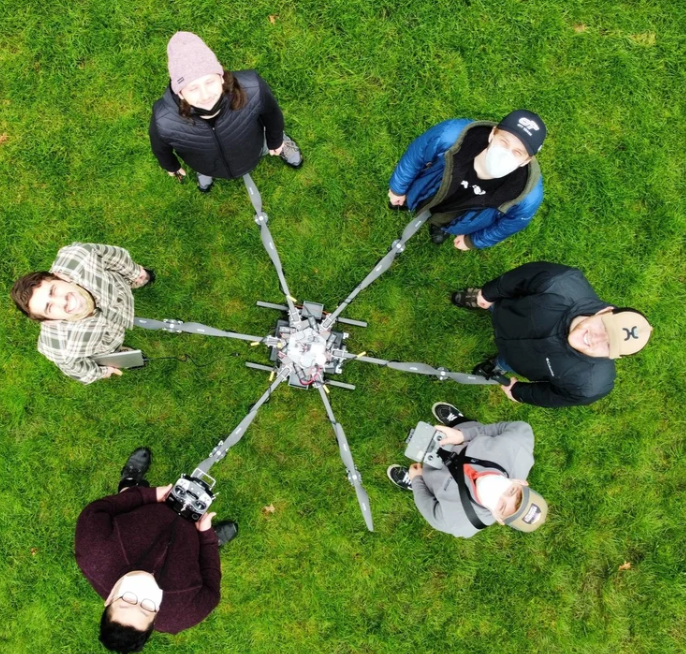
Agricultural Drone
The goal for this project was to improve accessibility of unmanned aerial vehicles (UAVs) for agricultural use in low-income countries. To do this, they were designing an open-source and easy-to-repair agricultural drone that can deposit payloads (such as a liquid silica solution) autonomously over a field.